

The year is 2389. It's a beautiful, sunny day in early spring.
Riven sits by their bedroom window, staring out at the garden that they will soon restore with their family. It's an annual tradition, one handed down through the ages. There is no need to grow food anymore, of course. Not in a society where everyone's needs are met. But the act of doing so connects them to the traditions of their ancestors. It also gives them a way to pay tribute to Terra, the spirit of the Earth.
"Riven! Riven!"
Mirae, their younger sibling, bursts into the room. "Come on! We're going to be late for Fart Day!"
Riven sighs, but follows them anyway.
"Don't forget your wig!" Mirae says, already halfway down the hall.
Riven grabs it on the way out.
The two siblings walk with their family to the town square. Neighbors trail along, either just ahead of or just behind them. It's a joyous occasion. There is laughter. There is friendship. Everyone seems to be in a jovial mood. Almost everyone, anyway. In a world that lies centuries beyond our own, moody pre-teens still exist.
Riven knows little of the cataclysms that defined the earliest centuries of the millennium. Famines that spanned continents. Violent storms. Fuel shortages. Devastating earthquakes. A small but significant meteor strike somewhere in the late 2100s. Another global ice age. And war. So much war. Several global wars, in fact, before the calendar even turned 2100.
What finally ended the wars was not enlightenment, but exhaustion. When borders collapsed under the weight of climate migration and resource scarcity, maintaining nations became more expensive than abandoning them. Over time, the structures that rewarded hoarding and domination simply failed to function, and the ones that favored coordination endured. The world didn’t become kinder. It became constrained.
Riven is dimly aware that these things happened, but like most people their age is far more interested in toys and friends and school. The family reaches the town square. One person climbs up onto the stage and welcomes the jubilant crowd with a short speech.
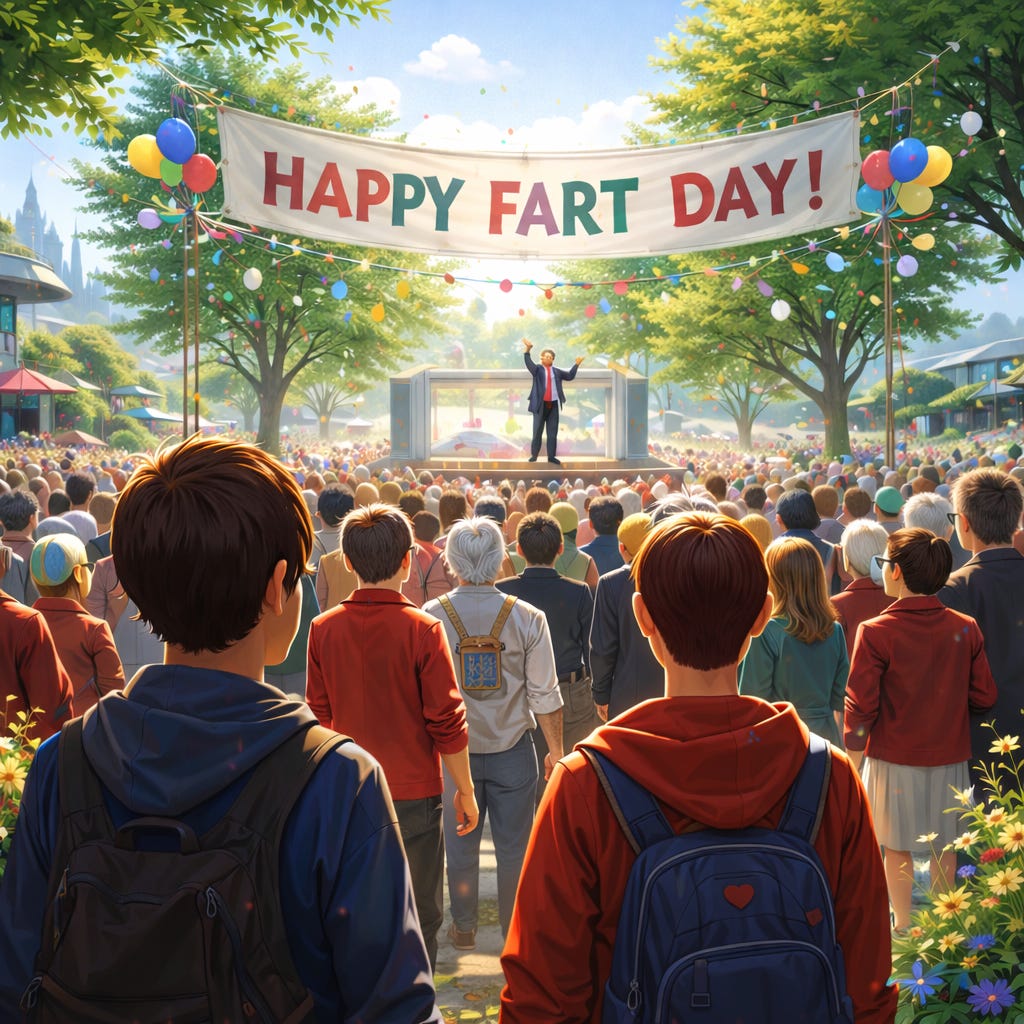
Riven's mind wanders. To them, Fart Day is just another stupid holiday. A silly one. The kind of day that even a child can find to be too juvenile.
"Everybody!" cries the announcer. "Please put on your masks and wigs now!"
Riven doesn't understand the wig. It's thin, light, and wispy. It makes Riven look much older the moment it covers their head, but they wear it anyway.
Many people in the crowd put on the same hairpiece. A couple are dressed in poorly-fitting suits. Others, those who don't own either, simply wear something red.
The crowd, led by the announcer, counts down: "Three! Two! One!"
In unison, nearly 3,000 people begin blowing raspberries. With short pauses to catch their breath, they keep it up for exactly forty-seven seconds.
Nobody knows why the number forty-seven was chosen for the holiday, or why or how the quirky celebration known as Fart Day became an annual tradition. If they did, then they would know that as our international borders dissolved our languages also began to blend. Somewhere between World War V and the collapse of nearly every technological pillar of society, the American President Donald Trump became conflated with the word 'trump' in British slang. And thus, 200 years later, Fart Day was born.
After the annual Fart, the townspeople gather and mingle. Some make plans for the weekend. Others offer to help each other with household chores. Riven knows there will be things to do tonight, but is excited because the family will also have company for dinner.
As they walk home, Riven thinks about this and realizes, quietly and without ceremony, that's what Fart Day is all about.
Bringing people together so they can never be divided again.
I met a traveller from an antique land,
Who said—“Two vast and trunkless legs of stone
Stand in the desert. . . . Near them, on the sand,
Half sunk a shattered visage lies, whose frown,
And wrinkled lip, and sneer of cold command,
Tell that its sculptor well those passions read
Which yet survive, stamped on these lifeless things,
The hand that mocked them, and the heart that fed;
And on the pedestal, these words appear:
My name is Ozymandias, King of Kings;
Look on my Works, ye Mighty, and despair!”
Nothing beside remains. Round the decay
Of that colossal Wreck, boundless and bare
The lone and level sands stretch far away.
Ozymandias, by Percy Bysshe Shelley (1792 - 1822)